
Mastering Industrial Automation: Why a PLC Programming Course in India is Your Gateway to a High-Tech Career
Industrial automation is transforming how factories, manufacturing plants, and processing units operate across the globe. Behind every smooth-running assembly line, automated packaging system, and precision robotic arm lies a sophisticated network of controllers and programming logic. If you want to build a high-paying, future-proof career in core engineering, enrolling in a PLC programming course in India is one of the smartest professional moves you can make today.
As industries rapidly adopt smart manufacturing, Industry 4.0, and Internet of Things (IoT) integrations, the demand for skilled automation professionals has skyrocketed. Whether you are a fresh university graduate looking to break into the core sector or an experienced professional wanting to upgrade your technical skill set, understanding programmable logic controllers is essential.
The Industrial Revolution 4.0: Understanding Modern Automation
The landscape of manufacturing has evolved dramatically over the last few decades. Gone are the days of purely manual labor and hard-wired relay control panels that required hours of troubleshooting whenever a single wire frayed. Modern industrial facilities rely on integrated digital ecosystems where machines talk to machines, data is analyzed in real-time, and safety protocols are managed digitally.
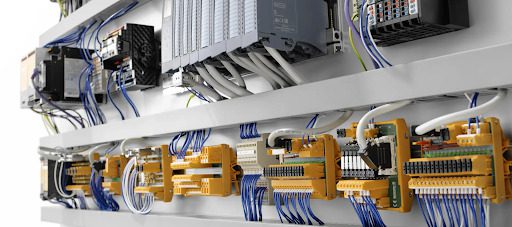
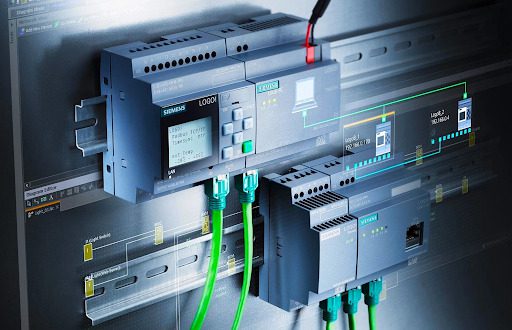
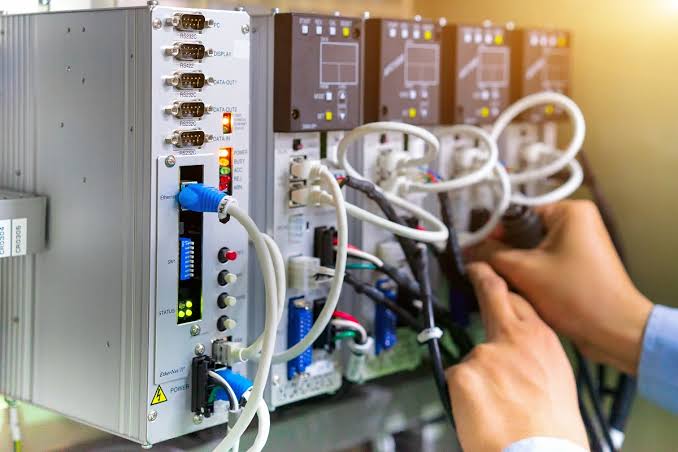
At the heart of this transformation is the Programmable Logic Controller (PLC). A PLC is a ruggedized industrial computer designed to withstand harsh factory environments—vibrations, extreme temperatures, humidity, and electrical noise. It continuously monitors input devices, makes logical decisions based on its custom user-programmed software, and controls output actuators to run complex industrial machinery.

What is a PLC Programming Course and Who Is It For?
A comprehensive PLC programming course is designed to take learners from absolute beginners to confident automation engineers. These programs bridge the gap between theoretical electrical engineering concepts and practical, hands-on industrial deployment.
Target Audience
- Engineering Graduates & Freshers: Electrical, electronics, mechanical, and instrumentation graduates seeking high-growth career opportunities in core industries.
- Working Professionals: Maintenance engineers, plant operators, and technicians wanting to transition from traditional hardware troubleshooting to advanced software-based automation.
- Tech Enthusiasts: Individuals looking to merge traditional automation with modern computing paradigms.
Core Pillars of a Comprehensive Curriculum
When looking for an industry-grade learning path, a well-structured PLC programming course must cover both foundational electrical logic and advanced system networking. Below is an overview of what a robust training curriculum entails.
1. Fundamentals of Industrial Electricity and Sensors
Before writing a single line of code, an automation engineer must understand how physical signals enter and leave a control system.
- Digital vs. Analog signals
- Working principles of proximity sensors, photoelectric sensors, limit switches, and encoders
- Relay logic, contactors, and motor control circuits (Direct Online Starters, Star-Delta starters)
- Safety circuits, emergency stops, and grounding techniques
2. PLC Architecture and Hardware Configuration
Understanding the internal anatomy of a controller ensures safe and efficient wiring practices.
- Central Processing Unit (CPU), memory modules, and power supplies
- Input/Output (I/O) addressing (Discrete and Analog I/O modules)
- Communication racks, backplanes, and expansion modules
- Sinking and sourcing concepts in DC field wiring
3. Mastering IEC 61131-3 Programming Languages
A standard PLC programming course teaches multiple languages defined by the International Electrotechnical Commission (IEC), allowing engineers to adapt to different brand ecosystems.
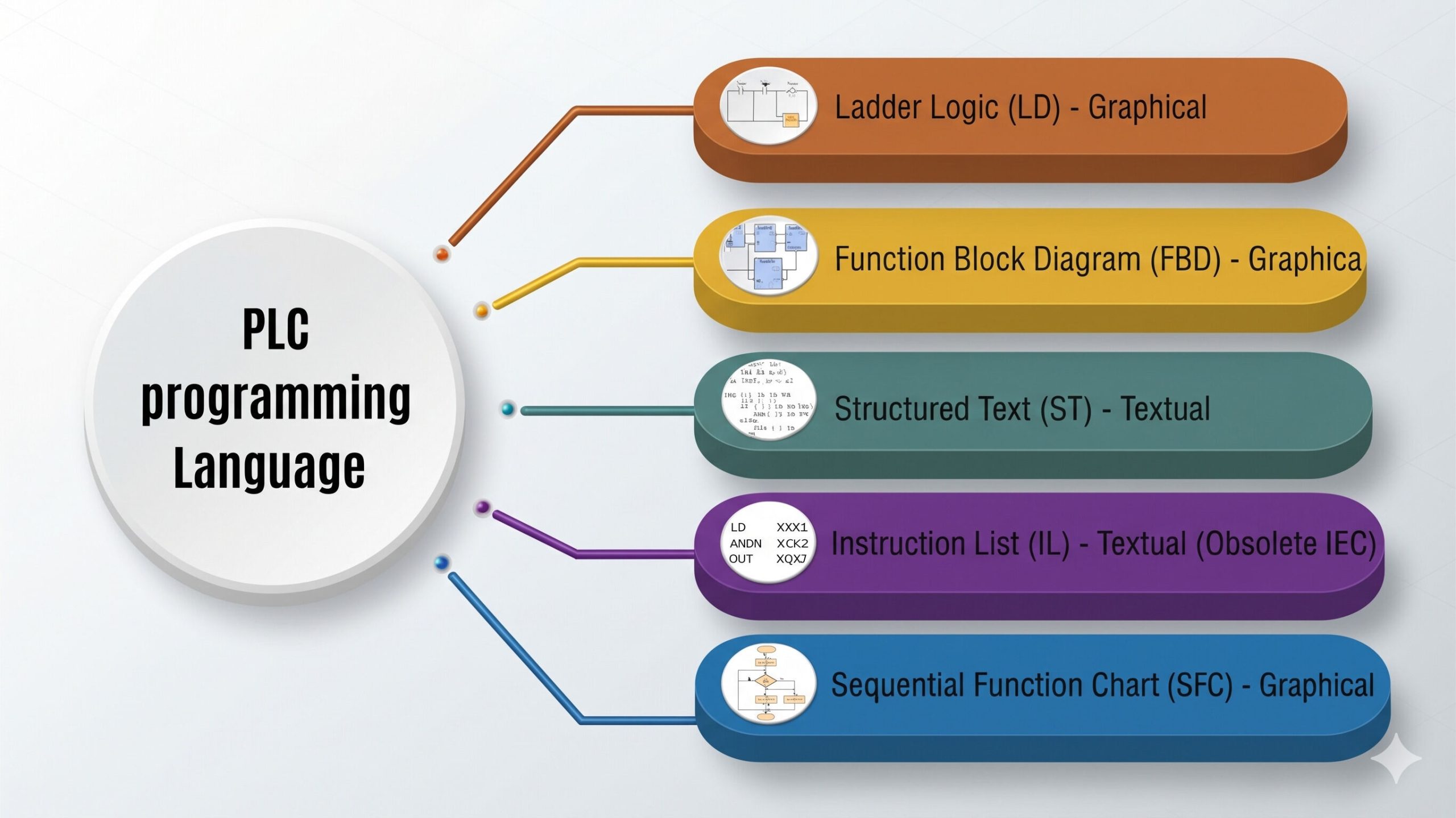
- Ladder Diagram (LD): The most widely used graphical language mimicking traditional relay schematics.
- Structured Text (ST): A high-level, text-based language similar to Pascal or C, ideal for complex mathematical computations and data manipulation.
- Function Block Diagram (FBD): Great for signal processing and continuous control loops.
- Sequential Function Chart (SFC): Perfect for step-by-step batch processes and sequential operations.
Comparison of Industrial Automation Programming Languages
To choose the right approach for a specific industrial application, it helps to compare the primary programming languages taught in a professional PLC programming course:
Industrial automation relies on several key programming languages defined by international standards. The Ladder Diagram (LD) uses graphical relay-style rungs and is beginner-friendly, making it ideal for basic Boolean logic and motor control. For advanced math, data arrays, and algorithms, Structured Text (ST) provides a high-level text syntax similar to traditional coding languages. When dealing with continuous process control and analog scaling, engineers utilize Function Block Diagram (FBD), which features interconnected visual blocks. Finally, Sequential Function Chart (SFC) uses step and transition blocks to manage complex batch processing and sequential machine states.
Advanced Integration: Beyond Basic Ladder Logic
Modern industrial automation does not exist in a vacuum. To stay competitive, a top-tier PLC programming course must connect PLCs with surrounding technologies like HMI, SCADA, and cloud databases.
Human-Machine Interface (HMI) Design
Operators need a visual window into what the PLC is doing inside the control cabinet. HMI screens provide touch-enabled dashboards for monitoring temperatures, pressures, valve statuses, and alarm logs. Learning screen development, tag linking, and alarm configuration is a critical skill.
Supervisory Control and Data Acquisition (SCADA)
For plant-wide monitoring, SCADA software aggregates data from multiple PLCs across a vast manufacturing floor. Students learn how to build dynamic graphical mimic diagrams, trend historical data, and generate automated shift reports.
Industrial Networking and Communication Protocols
PLCs must communicate with drives, sensors, and enterprise software. A robust curriculum covers industrial communication standards such as Modbus, Profibus, Profinet, and Ethernet/IP, enabling seamless data flow across the factory floor.
Why Choose Training in the Chandigarh and Mohali Region?
The Tricity region of Chandigarh, Mohali, and surrounding areas in Punjab and Haryana has rapidly evolved into a thriving hub for software development, IT services, and technical training. Choosing a regional technical institute offers distinct advantages:
- Industry Proximity: Close alignment with local manufacturing units, assembly plants, and technology parks.
- Expert Mentorship: Access to trainers with deep field experience in industrial automation and software engineering.
- Holistic Development: Combining core automation training with modern software skills like Python, IoT, and cloud computing creates versatile, highly employable engineers.
The Core Systems: Driving Excellence in Technical Education
At The Core Systems, we pride ourselves on being a premier software development and technology training organization based in the Chandigarh and Mohali region. We specialize in empowering university students and industry professionals with practical, future-ready technical skills.
Our educational ecosystem spans advanced training across multiple high-demand domains, ensuring our learners are fully equipped for the modern job market:
- Industrial Automation & Core Tech: Comprehensive instruction in PLC programming, embedded systems, IoT, IIoT, and industrial automation.
- Software Development & AI: Cutting-edge courses in Full-Stack Web Development (MERN stack, Python with AI), Data Science, and Data Analytics.
- Cloud & Infrastructure: In-depth training in AWS Cloud Computing, Cyber Security, and Linux system administration.
By blending rigorous theoretical foundations with intensive hands-on project execution, we bridge the gap between academic learning and real-world industrial demands across Punjab, Haryana, and beyond.
Career Opportunities and Salary Prospects
Completing a professional PLC programming course opens doors to numerous specialized job roles in core engineering sectors such as automotive, pharmaceuticals, oil and gas, food processing, water treatment, and robotics.
Popular Job Roles
- Automation Engineer: Responsible for designing, programming, testing, and commissioning PLC and SCADA systems.
- PLC Programmer / Software Engineer: Focuses purely on writing, debugging, and optimizing control algorithms for complex machinery.
- Maintenance & Troubleshooting Engineer: Ensures minimum factory downtime by diagnosing electrical and logical faults in automated lines.
- R&D Control Systems Specialist: Works on innovating next-generation smart factory frameworks and IoT-integrated equipment.
Salary packages for skilled automation professionals in India have seen steady upward growth, driven by the acute shortage of engineers who possess both strong logical programming skills and practical hands-on wiring knowledge.
Is hardware knowledge mandatory, or is PLC programming purely software-based?
Which programming language is taught first in a standard PLC curriculum?
How does PLC programming relate to Industrial IoT (IIoT) and Industry 4.0?
Can mechanical engineers build a successful career in PLC programming?
Contact Us
 WhatsApp us
